What Is a Pre-Leased Industrial Property? An Investor’s Guide for Gujarat

Pravin Parmar
Chief Marketing Officer | Published: 03 Nov 2026 | Updated: 03 Nov 2026 | 8 Min Read
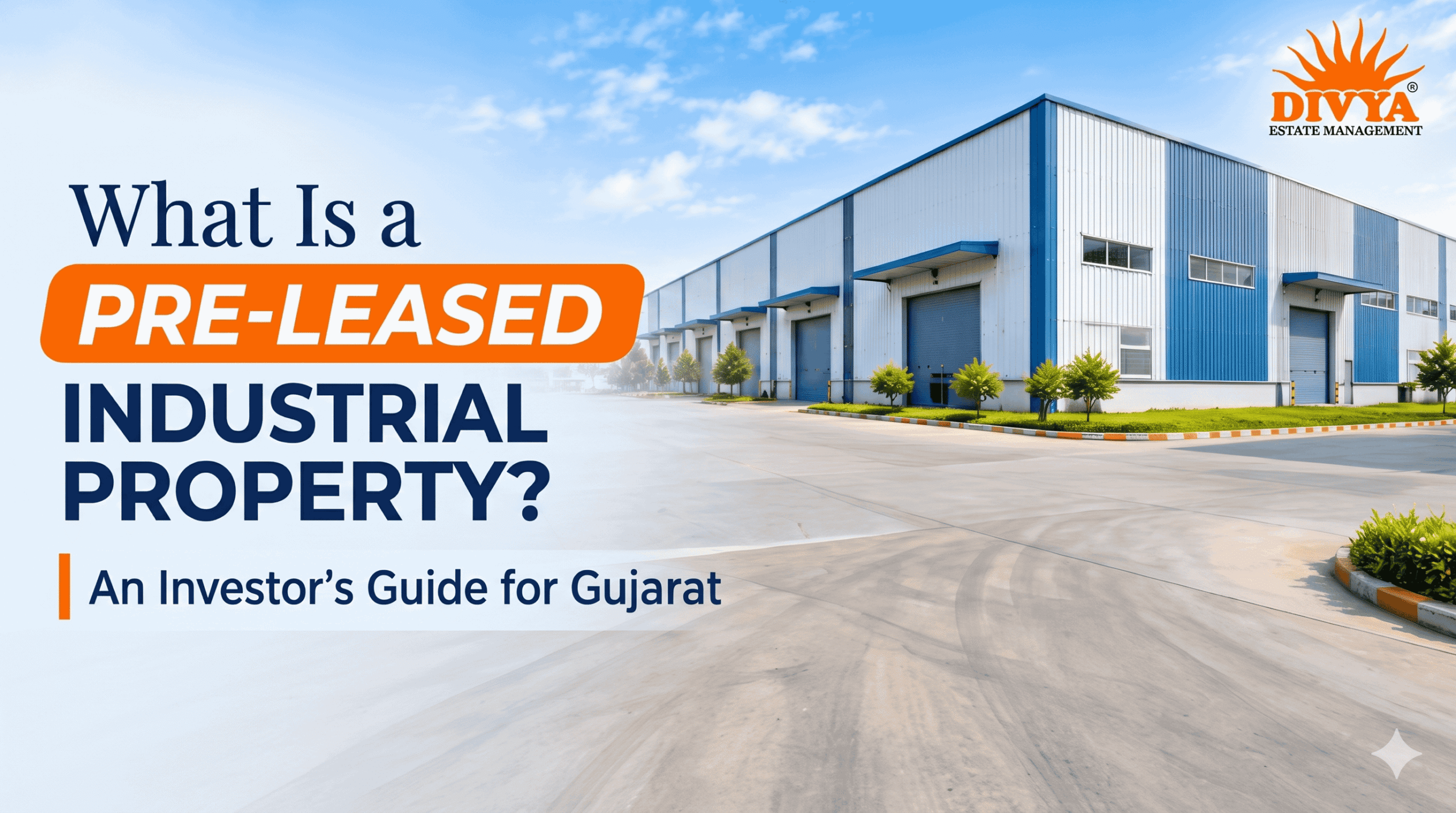
A pre-leased industrial property is an industrial shed or warehouse that is sold with a tenant already operating inside it and a lease agreement in force. The buyer steps into the landlord’s position and starts receiving rent from the first month, instead of waiting for a vacant building to find an occupant.
Gujarat’s industrial belts produce dependable pre-leased stock. Manufacturers on the Sanand, Changodar and Dahej belts commission plants that are expensive to move, and logistics operators around Ahmedabad and Vadodara build their distribution networks around a fixed address. Tenants like these tend to stay for years, and that stability is what an investor is really buying.
Key Takeaways
- A pre-leased industrial property is a shed or warehouse sold with a tenant and lease already in place.
- The lease continues with the new owner, along with the security deposit and escalation terms.
- The remaining lock-in matters more than the total lease term.
- Check the tenant, title and tax before you look at the rent figure.
- Long-term value depends on whether the building could be re-leased if the tenant leaves.
How a Pre-Leased Industrial Property Works
When an owner sells a leased shed or warehouse, the existing lease generally continues with the new owner as landlord. The rent, the security deposit held against the lease, and the escalation schedule pass to the buyer according to the terms of the sale and the lease itself. The tenant carries on with its operations, and for them the only real change is the account the rent is paid into.
When the sale completes, the tenant is usually given a letter confirming that rent is now payable to the new owner. Keep a copy for your records, along with the original lease and the deposit receipts.
How the transfer is documented varies from deal to deal, so the sale agreement and the lease should be reviewed by your own legal advisor before you commit.
Why Investors Choose Pre-Leased Industrial Property
Why Industrial Tenants Stay Longer
Industrial tenants invest heavily in the premises they occupy. Machinery foundations, power connections, racking systems, cranes and approvals tied to a specific address all make relocation costly and disruptive. As a result, lock-in periods on industrial leases are often longer than in office or retail space, and renewals are far more common than exits.
How the Rental Income Grows
The income also grows on a predictable path. In the leases we handle, rent typically escalates about 5% a year, so it rises every year without renegotiation. Day-to-day upkeep of the operating space usually sits with the tenant, which keeps the landlord’s involvement light. Demand is driven by manufacturing output and logistics volumes rather than office hiring cycles, and in our experience it has stayed steady along Gujarat’s established corridors.
How to Read the Yield
The usual starting measure is gross rental yield: annual rent divided by the purchase price. A property bought for ₹10 crore with annual rent of ₹75 lakh has a gross yield of 7.5%. These figures are for illustration only, not a market rate. Net yield, after property tax, insurance, any repairs you carry and an allowance for vacancy, is the fairer number to compare between properties.
Pre-Leased Industrial Sheds, Warehouses and Built-to-Suit Facilities
Pre-leased industrial sheds are usually occupied by manufacturers, and they often carry the longest tenures because a production line, once commissioned, rarely moves. Pre-leased warehouses attract logistics companies, third-party logistics providers and e-commerce operators. They cluster around highway nodes such as Changodar and Bavla, and along the routes towards Mundra and Kandla ports.
Built-to-suit facilities are a third route into the category. Here, an investor funds a facility designed to the specifications of a tenant who has already committed to occupy it, so the asset is effectively pre-leased before construction is complete. Divya Estate Management works with its investor network to structure these projects, matching the tenant’s technical requirements with an investor looking for long-term rental income.
Built-to-Suit: The Route In Between
If none of the ready sheds out there quite fit what you need, built-to-suit sits nicely between buying and leasing. An investor builds the facility to your spec, either on land they already own or on a plot they pick up for the project, and you lease it once it’s ready. You get a building designed around your process without putting your own money into land or construction. The trade-off is a longer commitment than a standard ready-shed lease, plus some waiting time while it’s built.
It’s a good fit if you’re leaning towards buying because you need a custom setup, but would rather keep your capital in the business. Divya Estate works with a network of investors who take on these projects, many with land already in hand. Our part is matching your requirements and timelines with the right investor and site.
What to Verify Before Buying a Pre-Leased Industrial Property
The rent figure is where the evaluation starts, not where it ends.
Tenant and Lease Terms
The tenant’s standing comes first: how long the company has operated at the site, the nature of its business, and its record of paying on time.
The remaining lock-in matters more than the total lease term. A nine-year lease with eight months of lock-in left is a very different asset from one with three years still ahead. Alongside this, confirm the escalation clause, the security deposit amount and how it will be transferred, and who bears property tax and major structural repairs.
Title and Approvals
Title and approvals need the same attention as they would on any industrial purchase. We do a preliminary title and approvals review before an option reaches your shortlist, and we recommend a full search by your own advocate as well. In practice, most decisions are a mix of all of this, so it helps to talk it over early, before you commit to a site or sign a lease.
Tax on the Rental Income
Rent from an industrial property attracts GST at 18%. If you are GST-registered, you charge it on your rent invoices. If you are not and the tenant is, the tenant may pay it under reverse charge. Tenants also generally deduct TDS before paying rent, so the amount you receive is net of tax and is adjusted against your income tax. Your CA can confirm how both apply to you.
In practice, most decisions are a mix of all of this, so it helps to talk it over early. With 25+ years of experience across Gujarat’s industrial corridors and more than 250 verified properties, Divya Estate can help you weigh each option against what your business actually needs. Whenever you’re ready, we’re happy to sit down and go through it with you.
Pre-Leased Industrial Property Checklist
Use this checklist as a quick reference when you review a pre-leased industrial property. Each point affects how secure the rental income is today and how easily the building can be re-leased later.
| Area | What to check | Why it matters |
|---|---|---|
| Tenant | Years at the site, nature of business, payment record | The tenant’s strength is what secures the income |
| Lock-in remaining | How much of the lock-in is still left | A long lease means little if the lock-in ends soon |
| Escalation | Rate and frequency written in the lease | Decides how the rent grows each year |
| Security deposit | Amount and how it transfers to you | You take on the refund when the tenant leaves |
| Repairs and property tax | Who carries structural repairs and property tax | Directly affects your net yield |
| Title and approvals | Clear title, NA status, building approvals | An unclear title puts the whole investment at risk |
| Re-leasability | Eave height, floor load, power, truck access, corridor demand | Decides how quickly a new tenant can be found |
| Tax on rent | GST registration and TDS on rent | Affects what you invoice and what you receive |
The Question Most Buyers Skip: Can the Building Be Re-Leased?
Every tenant leaves eventually, and the long-term value of a pre-leased industrial property depends on whether the next tenant would want the same building. Eave height, floor load capacity, sanctioned power, crane provision and truck access all decide how quickly a vacated shed finds a new occupant, and so does the strength of demand in that particular corridor.
A building heavily customised for one manufacturing process can sit empty for months once its tenant moves out. A well-specified shed in an active industrial estate or GIDC area rarely does. Judging this before you buy is where local market knowledge earns its keep.
How Divya Estate Management Helps
We’ve worked across Gujarat’s industrial belts since 2000, from Ahmedabad and Vadodara to Bharuch and Gandhidham. When we assess a pre-leased industrial property for an investor, we look at the lease and the building together, so the income you buy today is backed by an asset the market will still want tomorrow.
Our database covers 250+ verified properties across Gujarat. We review the tenant, lease terms and title before an option reaches your shortlist, then support the negotiation and documentation through to transfer.
If you are evaluating a pre-leased industrial property in Gujarat, speak with our team before you commit.
Frequently Asked Questions
What is a pre-leased industrial property?
It is an industrial shed or warehouse sold with a tenant already operating inside and a lease in force. The buyer becomes the landlord and receives rent from the first month, instead of waiting for a vacant building to find an occupant.
Does the lease continue after a pre-leased property is sold?
Generally, yes. The existing lease continues with the new owner as landlord, and the rent, security deposit and escalation terms pass to the buyer under the sale and lease documents. Have your own legal advisor review both before you commit.
How do I calculate the rental yield on a pre-leased property?
Divide the annual rent by the purchase price and multiply by 100 to get the gross yield. For a fair comparison between properties, work out the net yield too, after property tax, insurance, any repairs you carry and an allowance for vacancy.
Is GST and TDS applicable on rent from a pre-leased industrial property?
Yes. Rent from industrial property attracts GST at 18%, charged by you if you are registered, or paid by a registered tenant under reverse charge if you are not. Tenants generally deduct TDS before paying rent. Confirm the details with your CA.
Who pays for repairs and property tax on a pre-leased property?
It depends on the lease. Day-to-day upkeep of the operating space usually sits with the tenant, while structural repairs and property tax are often the landlord’s. Check the lease wording before you buy.
Does Divya Estate Management help investors buy pre-leased industrial property?
Yes. We shortlist pre-leased sheds, warehouses and built-to-suit opportunities across Gujarat, review the tenant, lease and title, and support the negotiation and documentation through to transfer.
Looking at Pre-Leased Industrial Property?
Tell us your budget, preferred location and the kind of tenant you’d like, and we’ll come back with verified pre-leased sheds, warehouses and built-to-suit opportunities.
Author
Pravin Parmar
Mr. Pravin Parmar has served as Chief Marketing Officer at Divya Estate Management for nearly two decades, bringing expertise in industrial real estate. He leads the firm’s market positioning and works directly with investors and clients on transaction structure.
Related Blogs
Home Blog Buy vs Lease Industrial Property Industrial Property What Is a Pre-Leased Industrial Property? An Investor’s Guide for Gujarat

Home Blog Buy vs Lease Industrial Property Industrial Property Buy vs Lease Industrial Property in Gujarat: A Guide SH Rana
Industrial Property · Gujarat