Built-to-Suit vs Ready Industrial Shed: Two Questions That Settle It

Dinesh Rana
Chief Operating Officer | Published: 05 Nov 2026 | Updated: 05 Nov 2026 | 6 Min Read
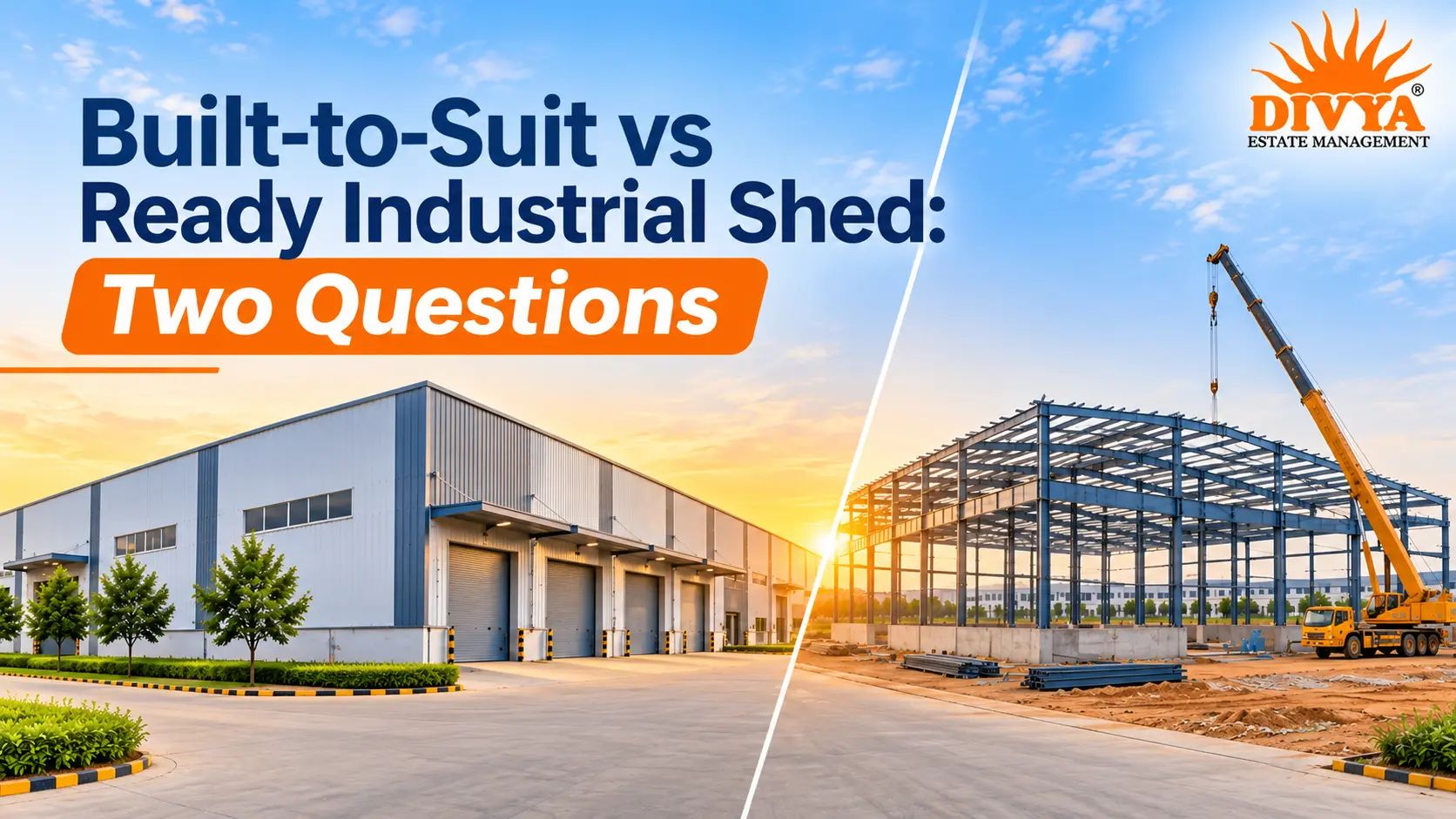
If you’re planning a new unit or an expansion in Gujarat, you’ve likely weighed two routes already. You can move into a ready industrial shed, or you can commission a built-to-suit industrial facility designed around your process. Both are sound choices, and plenty of successful manufacturers in the Ahmedabad region have gone either way.
A built-to-suit facility (also called build-to-suit, or BTS) is a building designed and constructed for one tenant’s operation, usually by an investor or developer who then leases it to that tenant.
So which one is right for you? In our work with tenants across the Sanand, Changodar, Bavla and Chhatral belts, the built-to-suit vs ready industrial shed decision usually comes down to two questions. How soon do you need to be producing? And how much of your requirement is built into the structure itself? Get clear answers to those, and the decision tends to make itself.
Key Takeaways
- Start with your production date. It rules options in or out fastest.
- A ready shed can be running in weeks. Built-to-suit takes much longer.
- Internal gaps can be fixed after move-in. Structural ones usually can’t.
- Built-to-suit means a longer lease than a ready shed.
- A ready shed with pre-handover changes is often a middle route.
Looking for an industrial shed on lease in Gujarat? You’re honestly spoilt for choice. Ready sheds of nearly every size are available across Ahmedabad, Vadodara, Bharuch, Surat and the Gandhidham and Kutch belt.
Here’s the catch, though. With this much choice, it’s natural to shortlist on rent, size, and how close the shed is to the highway. But the things that actually cost tenants money usually show up after they’ve moved in. Maybe the power connection can’t carry the load, or the belt sees frequent cuts. Maybe the approach road turns into a pond every July. Or there’s a lease clause nobody read properly.
You probably already know what your operation needs. So treat this as a checklist for confirming that the shed you’ve shortlisted actually delivers it, before you sign anything.
Start With Your Production Date
Most expansion plans already have a date attached. A new order is coming in, a lease is ending, or a second line has to be running by a particular quarter. That date is the best place to begin, because it rules options in or out faster than anything else.
A ready industrial shed is already standing. Once the space is shortlisted, the paperwork is done and you’ve set up your machinery, you can be operational within weeks. If your timeline is tight, that speed is hard to beat.
A built-to-suit project runs on a different clock. The land has to be identified, approvals obtained, the design agreed and the building constructed before you get the keys. Depending on the site and the scale of the structure, that can stretch to the better part of a year. It’s well worth the wait when the building needs to match your process closely, but it only works if your plan has room for it.
So the first check is simple. Work back from the day production must start, and see whether a built-to-suit timeline fits inside that window. If it doesn’t, your search narrows to ready sheds, and the real question becomes how well one can match your requirements.
Which Gaps Can a Ready Industrial Shed Close?
No ready shed will match your wish list exactly. That’s expected. What matters is the kind of gap you’re looking at, because some are easy to close and others are built into the structure.
Internal Gaps You Can Close After Moving In
The easy ones sit inside the building. An office block, extra loading docks, better lighting, a mezzanine for storage or a revised internal layout can usually be added after you move in. Many owners are open to discussing these, and the cost is manageable when you compare it with waiting for a new building.
Structural Gaps That Stay With the Building
The harder gaps are part of the frame and foundation. Floor load capacity, eave height, column spacing and the provision for crane girders were all decided when the shed was designed. Sanctioned power works much the same way, since upgrading it is a separate process with its own timeline. If your operation depends on a 10-tonne overhead crane or heavy presses that need a reinforced floor, a shed that falls short here won’t become suitable with modest changes.
This is where a built-to-suit industrial facility earns its place. When the gaps on your list are mostly structural, designing the building around your process often costs less, in time and money, than trying to make an existing shed work. When the gaps are mostly internal, a ready shed with a few modifications is usually the more practical route.
The fire NOC should match how you’ll actually use the space. An approval for storage won’t always cover a manufacturing process.
Pollution consent works on two levels. On the shed side, we can shortlist properties that have already housed similar activity, which narrows things down quickly. Your own Consent to Establish and Consent to Operate from GPCB are yours to obtain, so check early that your industry category is allowed in that zone or estate.
Plan the timeline too. If your consents take a few months and rent starts the day you sign, you’re paying for a shed you can’t use yet. A rent-free fit-out period helps here, and we’ll get to that under lease terms.
What a Built-to-Suit Commitment Involves
It helps to go in knowing what the investor is taking on. A built-to-suit building is designed for one tenant’s operation, so the owner is investing in something shaped around your needs. Lease terms usually reflect that, with a longer commitment than you’d see on a ready shed, where local owners, in our experience, typically look for around three years at minimum.
For a manufacturer planning to stay put and grow on the same site, this is rarely a concern. It simply means the decision deserves a clear view of where your operation will be several years from now, and not only where it is today.
The Middle Ground Between BTS and Ready Sheds
The choice isn’t always one or the other. Quite a few of our clients end up somewhere in between, and it often turns out to be the best fit.
One version is a ready shed where the owner agrees to carry out specific modifications before handover, such as adding docks, extending the office or upgrading the flooring in one bay. You get most of what a custom building offers, on a much shorter timeline. Another is a shed that’s still under construction, where there’s time to adjust the layout or certain specifications before it’s finished.
Neither works for every requirement. If your process needs a heavy crane or a very specific floor plan, a full built-to-suit facility is still the cleaner answer. But if your list is mostly internal changes with one or two structural asks, it’s worth exploring these options before committing to a longer build.
Then ask whose name the connection is in and whether there are any pending dues, because unpaid bills can lead to disconnection even after you’ve taken over. Agree on billing upfront, whether through a separate meter or a sub-meter. And ask the neighbours how often power goes out in that belt. If cuts are frequent, you’ll want DG backup, or at least the space and permission to install one.
Water deserves the same attention, especially for water-intensive processes. Find out whether supply comes from a borewell, GIDC, or the municipality, and how reliable it is through summer. If your process generates effluent, check the drainage and treatment arrangements too.
Built-to-Suit vs Ready Industrial Shed at a Glance
Use this comparison as a quick reference when you weigh the two routes. Your production date and the type of gaps on your list will usually point clearly to one column.
| Factor | Ready Industrial Shed | Built-to-Suit Facility |
|---|---|---|
| Time to start | Weeks, once paperwork and machinery set-up are done | Often the better part of a year, depending on site and scale |
| Fit to your process | Close, with internal changes after move-in | Designed around your process from the start |
| Floor load, eave height, column spacing | Fixed when the shed was built | Set to your requirement |
| Crane provision | Only if the shed was designed for it | Planned into the structure |
| Sanctioned power | Existing load; upgrades take time | Planned into the project |
| Lease commitment | Around three years minimum, in our experience | Longer, reflecting the owner’s custom investment |
| Best suited to | Tight timelines and mostly internal gaps | Structural requirements and long-term plans |
How Divya Estate Management Helps
We’ve worked across Gujarat’s industrial belts since 2000. By the time most tenants contact us, they already know their process well. What helps is laying their specifications next to what’s actually available and seeing which gaps are real.
Our database covers 250+ verified properties across Gujarat. We shortlist ready industrial sheds that match your requirements and flag where a building falls short. When built-to-suit is the better route, we connect you with an investor from our network and help align the build with your production date.
If you’re weighing a built-to-suit industrial facility against a ready industrial shed for your next move in Gujarat, share your production timeline and key specifications with us, and we’ll help you see which path fits.
Frequently Asked Questions
What is a built-to-suit industrial facility?
It is a building designed and constructed for one tenant’s operation, usually by an investor or developer who then leases it to that tenant. The structure, floor, power and layout are planned around the tenant’s process from the start.
How do I choose between built-to-suit and a ready industrial shed?
Start with two questions: how soon you need to be producing, and whether your requirements are structural or internal. A tight timeline with mostly internal needs points to a ready shed. Structural needs and longer plans point to built-to-suit.
How long does a built-to-suit project take?
It depends on the site and the scale of the building. Land, approvals, design and construction all have to be completed before handover, which can take the better part of a year. A ready shed can be operational within weeks.
Can a ready industrial shed be modified before I move in?
Often, yes, with the owner’s agreement. Additions such as loading docks, an office extension or upgraded flooring in one bay can be carried out before handover. Agree the scope and cost in writing before you sign.
Which shed specifications can’t be changed later?
Floor load capacity, eave height, column spacing and crane girder provision are fixed when the shed is designed. Sanctioned power can be increased, but the upgrade is a separate process with its own timeline.
Does Divya Estate Management help with built-to-suit projects?
Yes. We work with a network of investors who take on built-to-suit projects, many with land already in hand. We match your specifications and timeline with the right investor and site, and we also shortlist ready sheds so you can compare both routes.
Built-to-Suit or Ready Shed?
Share your production date, size, power and crane requirements, and we’ll show you which route fits, with verified options for each.
Author
Dinesh Rana
Oversees planning and operations across industrial and commercial real estate transactions at Divya Estate Management, working with manufacturers and logistics operators on site selection, lease negotiation and possession across Gujarat’s industrial belts.
Related Blogs
Home Blog Built-to-Suit vs Ready Industrial Shed Manufacturing Built-to-Suit vs Ready Industrial Shed: Two Questions That Settle It Dinesh Rana
Home Blog Evaluate Industrial Land Industrial Land How to Evaluate Industrial Land in Gujarat Before You Buy SH Rana CEO
Home Blog Buy vs Lease Industrial Property Industrial Property What Is a Pre-Leased Industrial Property? An Investor’s Guide for Gujarat
Industrial Property · Gujarat
Need Industrial Space in Gujarat?
Looking for a warehouse, shed, factory or industrial land or just want to talk through the options first? He is happy to help.