Industrial Land Purchase Process in Gujarat: Step by Step

SH Rana
CEO & Managing Director | Published: 18 Nov 2026 | Updated: 18 Nov 2026 | 8 Min Read
If you’ve bought industrial land in Gujarat before, you already know the drill. Grab a cup of chai and skim this for the bits that have changed. If it’s your first time, welcome. Gujarat’s industrial corridors stretch from Sanand and Becharaji through Halol and Savli, down to Dahej, and all the way out to Mundra and Kandla.
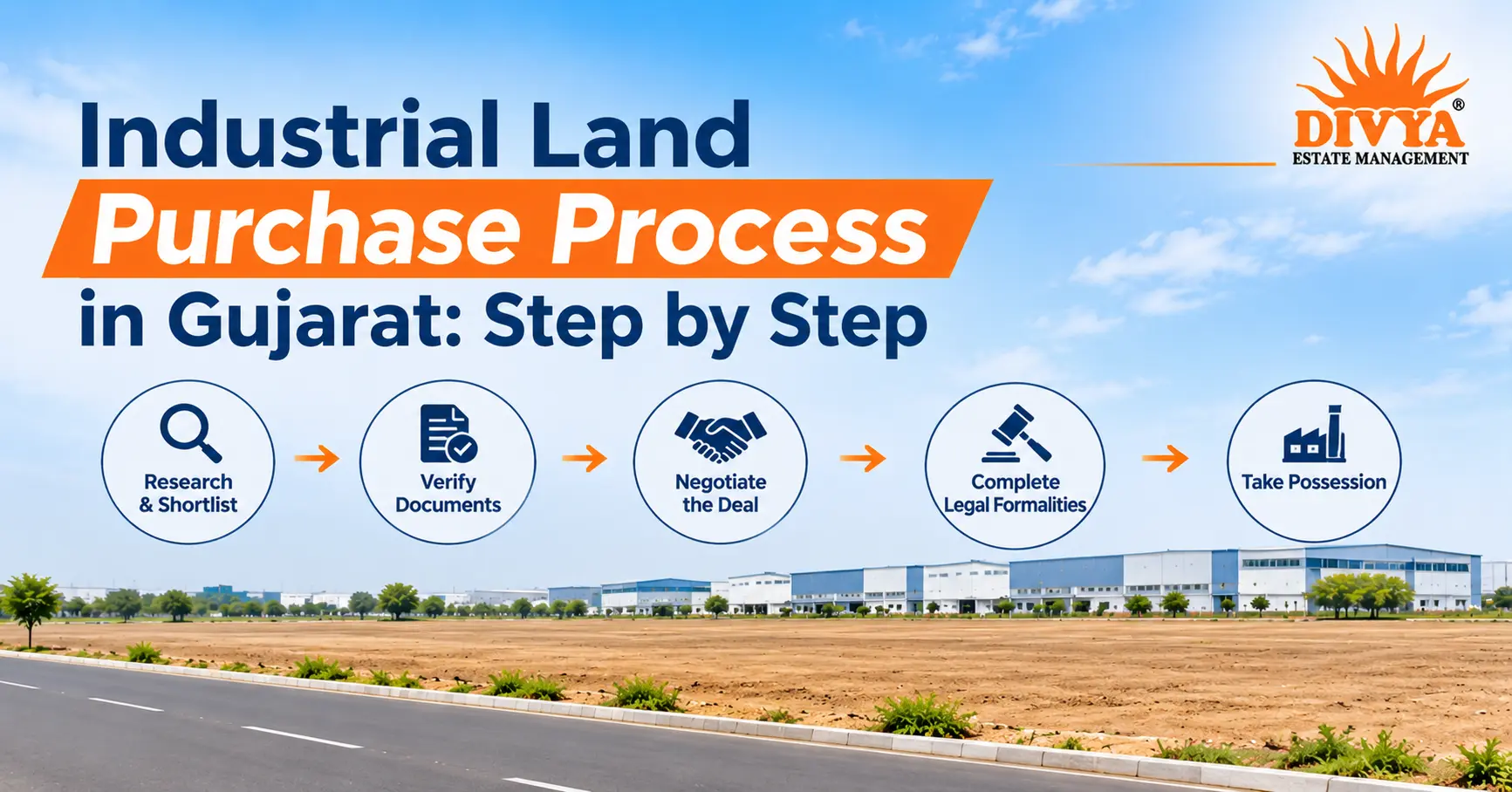
The land is out there. The real work is buying the right parcel with its paperwork in order, and Gujarat has a few local rules worth knowing before anyone shakes hands. The industrial land purchase process in Gujarat usually runs in six steps: choose the corridor, decide between a GIDC plot and private land, confirm the land can legally be used for industry, verify the title and every owner’s consent, budget stamp duty on the Jantri value, and register the sale deed. Here’s the short version, written for people who would rather be building than reading.
Key Takeaways
- Pick the corridor first, then the plot.
- GIDC means allotment. Private land means you own the checks.
- Agricultural land needs a legal route to industrial use.
- Every co-owner and heir must sign the sale deed.
- Stamp duty runs on the deed price or Jantri, whichever is higher.
Step 1: Pick the Corridor First, Then the Plot
Most buyers start with a budget and an acreage. Try starting with your trucks instead. Where do your raw materials come from, and where does the finished product need to go? An auto component maker wants a short run to Sanand and Becharaji. A chemicals unit feels at home around Dahej, Ankleshwar, or Jhagadia, where the effluent infrastructure and the approvals ecosystem already exist. Export-heavy cargo leans toward Mundra and Kandla. Get the corridor right and half your shortlist writes itself.
Step 2: Choose Between a GIDC Plot and Private Land
This is the first real fork in the road. A GIDC plot comes through allotment on a long lease, inside an estate with roads and utilities planned around it and its own rules on use and transfer. Private land gives you freedom on size, shape and timing, and usually more room to negotiate. The flip side is that the due diligence sits squarely on your desk. Neither route wins outright. It comes down to how fast you need to move and how much paperwork you’re happy to own.
Step 3: Confirm the Land Can Legally Be Used for Industry
Here’s where first-timers tend to get surprised. Plenty of land along these corridors is still on record as agricultural. In Gujarat, agricultural land can generally be bought only by an agriculturist. Section 63AA of the Gujarat Tenancy and Agricultural Lands Act, 1948 makes an exception for land bought for a bona fide industrial purpose. The buyer must inform the Collector within 30 days of the purchase, and conditions apply on putting the land to industrial use. Land that already carries an NA order for industrial use avoids that route altogether. Your advocate can confirm which route applies to the parcel you’re looking at.
Either way, ask one simple question before you fall for a price: is this land ready for industrial use today, and if not, what’s left to do and how long will it take? Every so often, a plot that looks like a steal has work still pending that the price doesn’t show. We flag this on the plots we put in front of you, so you hear about it before the token amount moves, not after.
The physical checks matter just as much: the approach road, power, water, soil, and drainage. We’ve covered them plot by plot in our guide to evaluating industrial land.
Step 4: Check the Title and Every Signature
The 7/12 extract and the 8A are the heart of any land deal in Gujarat, and you can pull both yourself on AnyROR, the state’s online land records portal, in a few minutes. What you’re really after is the story behind them. The mutation entries show who held the land and how it changed hands. Check whether every co-owner and heir has signed off, and whether a bank charge, a pending case, or an acquisition notice is sitting quietly in the records.
Rural land in Gujarat is often held jointly across generations, so one missing signature can stall a deal for months. We do a preliminary review of the records before a plot reaches your shortlist, and we recommend your own advocate run a full title search on the same papers. Two sets of eyes on a thirty-year mutation history never hurt anybody.
Step 5: Budget Stamp Duty on the Jantri Value
Stamp duty in Gujarat is 4.9%, made up of 3.5% basic duty and a 1.4% surcharge. It’s charged on whichever is higher: the price in your sale deed or the Jantri value for that zone and land class. A registration fee of 1% is payable on top. You can check the Jantri value for any survey number on the state’s GARVI portal.
At the time of writing, the Jantri in force is still the one notified in April 2023, which roughly doubled the earlier rates. A further revision was drafted in late 2024 and is yet to be notified. So budget on the current Jantri and keep one eye on the news. And if anyone suggests showing a lower price in the deed because duty runs on Jantri anyway, politely let that idea go.
Step 6: Register the Sale Deed and Update the Records
Once the price, the title, and the duty are settled, the sale deed is executed and registered at the sub-registrar’s office, with every seller who appears on the records signing. Registration isn’t the last step, though. The revenue records then need a mutation entry in your name, so that the 7/12 shows you as the owner. If you bought agricultural land under Section 63AA, the Collector also needs to hear from you within 30 days of the purchase. Keep certified copies of everything. Your bank, your approvals, and any future sale will all ask for them.
The Industrial Land Purchase Process at a Glance
Use this table as a quick reference for where you are in the process and who you’ll be dealing with at each step.
Step | What happens | Who’s involved |
1. Corridor | Match the location to raw materials, markets, and labour | You and your consultant |
2. GIDC or private | Apply for a GIDC allotment, or negotiate with the landowner | GIDC or the landowner |
3. Industrial use | Confirm the NA order, or buy under Section 63AA and inform the Collector within 30 days | Collector’s office, your advocate |
4. Title and consents | Check the 7/12, 8A and mutation entries; every co-owner and heir signs | Your advocate |
5. Stamp duty | 4.9% on the deed price or Jantri, whichever is higher, plus 1% registration | Sub-registrar |
6. Registration and mutation | Register the sale deed; mutation entry updates the records in your name | Sub-registrar, talati |
How Divya Estate Management Helps
Seasoned buyers don’t skip any of these steps. They just move through them faster, because they know which questions matter in which taluka. That local memory is what we bring. We’ve worked across Gujarat’s industrial corridors since 2000, from Sanand, Bavla and Halol to Dahej and Kutch.
Our database covers 250+ verified properties, from open land to sheds to built-to-suit options. We shortlist plots that fit your use, flag what’s pending on the paperwork, and coordinate site visits and documentation through to registration.
First parcel or fifth, if you’re starting the industrial land purchase process in Gujarat, tell us what you’re making and where it needs to go. We’ll come back with a shortlist that already fits.
Frequently Asked Questions
What is the process to buy industrial land in Gujarat?
It usually runs in six steps: choose the corridor, decide between a GIDC plot and private land, confirm the land can legally be used for industry, verify the title and every owner’s consent, pay stamp duty on the Jantri value, and register the sale deed followed by mutation.
Can a non-agriculturist buy agricultural land for industry in Gujarat?
Yes, under Section 63AA of the Gujarat Tenancy and Agricultural Lands Act, 1948, if the land is bought for a bona fide industrial purpose. The buyer must inform the Collector within 30 days of purchase, and conditions apply. Confirm the details with your advocate.
How much is stamp duty on industrial land in Gujarat?
Stamp duty is 4.9%, made up of 3.5% basic duty and a 1.4% surcharge, charged on the higher of the deed price or the Jantri value. A registration fee of 1% is payable on top.
What is the Jantri rate and why does it matter?
Jantri is the government’s minimum valuation for land and property in each zone of Gujarat. Stamp duty is charged on the Jantri value if it’s higher than your deed price, so it sets the floor for your duty budget. You can check it on the GARVI portal.
Is a GIDC plot bought or leased?
GIDC allots land on a 99-year lease, renewable for another 99 years, rather than selling it outright. In day-to-day terms, it works much like ownership, but GIDC’s own rules apply to use and transfer.
What happens after the sale deed is registered?
A mutation entry is made in the revenue records, so the 7/12 shows you as the owner. If you bought agricultural land under Section 63AA, you also need to inform the Collector within 30 days. Keep certified copies of all documents.
Does Divya Estate Management help with buying industrial land?
Yes. We shortlist plots that fit your use and corridor, flag what’s pending on the paperwork, arrange site visits, and coordinate documentation through to registration.
Buying Industrial Land in Gujarat?
Tell us your industry, preferred corridor, plot size, and timeline. We’ll come back with plots that fit, with the paperwork position flagged upfront.
Author
SH Rana
S.H. Rana founded Divya Estate Management in 2000 and has led the firm as CEO and Managing Director since. Headquartered in Ahmedabad, the company is among the earliest dedicated industrial real estate consultancies in Gujarat, with over 25 years in the market and 500+ industrial clients served.
Related Blogs


Industrial Property · Gujarat